


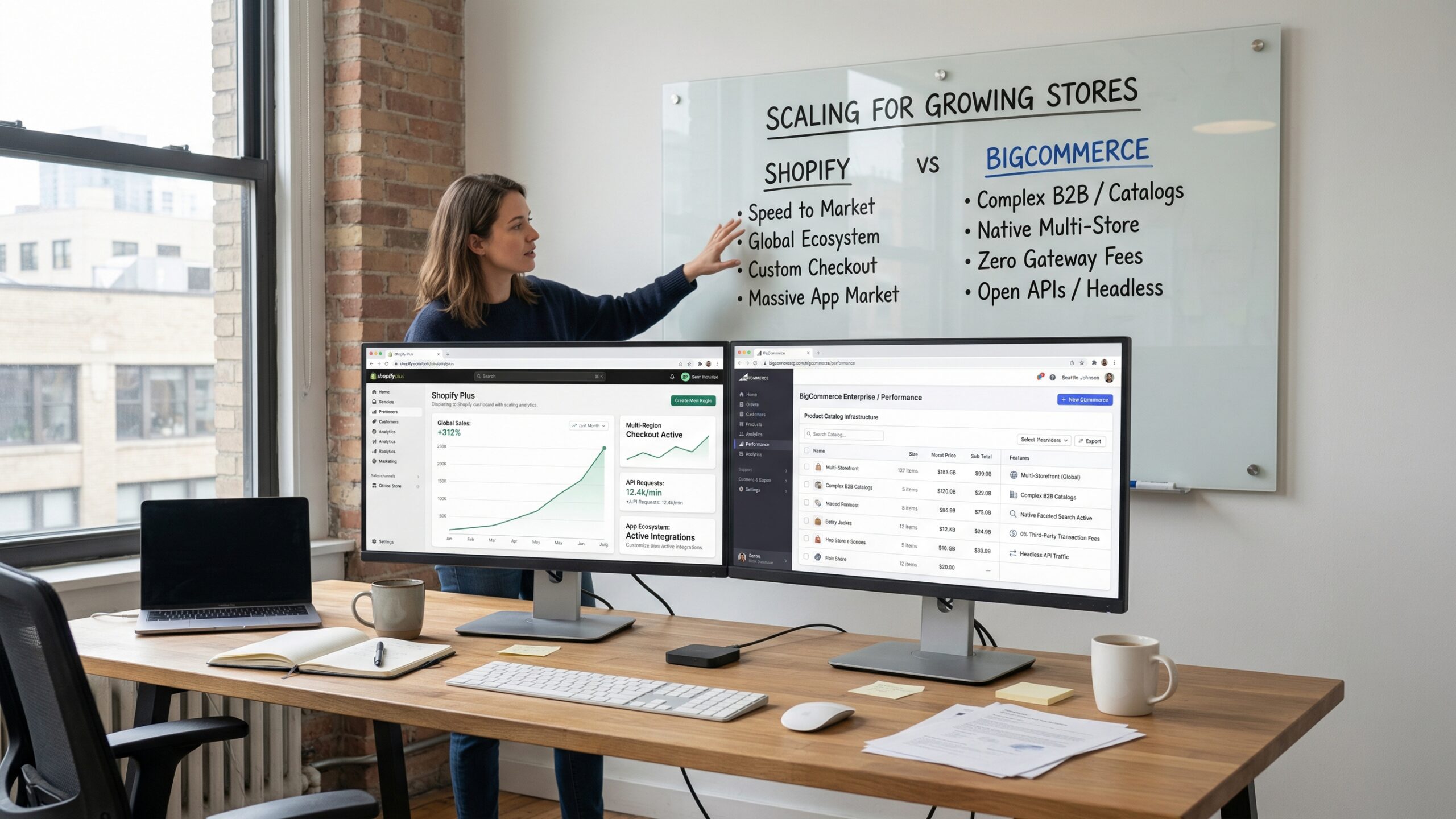
I get asked some version of the Shopify vs BigCommerce question about twice a week. Usually it comes from a founder who just crossed a revenue milestone and suddenly feels the platform creaking underneath them. Sometimes it comes from an operations lead whose app bill now costs more than the warehouse lease. Once in a while it comes from a CFO who opened an invoice and found a fee they didn’t know existed.
My job is to design commerce stacks without a horse in the race. I don’t take referral money from either platform, and over the years I’ve moved stores in both directions: Shopify to BigCommerce, BigCommerce to Shopify, and a few off both onto something else entirely. That history is why I’m skeptical of comparison posts that crown a winner in the first paragraph. Both platforms can carry a store from $50,000 a year to $50 million. They just make you pay for growth in different currencies.
So instead of a feature checklist, I want to walk through what scaling actually costs on each platform as of late 2026, where each one tends to break, and the framework I use with clients when the decision is real money.
Why the Shopify vs BigCommerce Answer Changed in 2026
If you read a Shopify vs BigCommerce comparison written before mid 2026, set it aside. A good chunk of it is now wrong.
For years, the simplest pitch BigCommerce had was “no transaction fees.” Shopify charged you extra for using an outside payment gateway; BigCommerce didn’t. That line was the deciding factor in plenty of boardrooms I’ve sat in.
On June 1, 2026, BigCommerce rebuilt its pricing. The plans were renamed (Standard became Core, Plus became Growth, Pro became Scale, and Enterprise became Performance), the revenue caps on the two entry plans dropped, and a new Open Payment Provider Fee arrived for stores that process payments through gateways outside BigCommerce’s approved list. BigCommerce now names 21 embedded providers, including its own BigCommerce Payments, Adyen, Checkout.com, Klarna and Amazon Pay, and orders through those carry no extra fee. Anything else is classed as “open” and gets charged.
Shopify, meanwhile, quietly removed one of its oldest technical complaints. In October 2025, it raised the variant limit from 100 to 2,048 per product for every merchant, not just Plus stores. That one change knocked out a reason I used to steer apparel and parts sellers toward BigCommerce.
The upshot: the two platforms are closer on cost than they’ve ever been, and the old shortcuts no longer work. You actually have to do the math.
What “Scaling” Means When I’m Designing a Store
When a client says they need a platform that scales, they usually mean one of four different things, and the right answer depends on which one is keeping them up at night.
Revenue scale. Will my platform bill grow sensibly as sales grow, or will it jump at awkward thresholds?
Catalog scale. Can the platform handle thousands of SKUs, deep variant trees, complex pricing rules and multiple warehouses without hacks?
Channel scale. Can I run multiple brands, regions, currencies or a wholesale arm from one back office?
Technical scale. When I plug in an ERP, a PIM, a 3PL and a custom pricing engine, will the APIs hold up under real traffic?
Most stores feel one of these well before the others. A DTC skincare brand with 40 products hits revenue scale first. A distributor with 30,000 SKUs hits catalog and technical scale before revenue ever becomes an issue. Keep your own pressure point in mind as you read the rest.
Shopify vs BigCommerce Pricing: What Growth Really Costs
Shopify vs BigCommerce Plan Ladders Side by Side
On the Shopify side, the main US plans are Basic at $39 a month, Grow at $105, Advanced at $399, and Shopify Plus starting at $2,300 a month on a three year term (around $2,500 on a one year term). Annual billing knocks the lower tiers down a bit.
BigCommerce now mirrors that ladder almost to the dollar on paper: Core at $39 a month ($29 billed annually), Growth at $105 ($79 annually), Scale at $399 ($299 annually), and Performance with custom pricing starting from $1,499 a month billed annually.
If you stopped there, you’d say they’re identical. They aren’t, because of what happens as revenue climbs.
BigCommerce’s Revenue Caps
BigCommerce ties each self serve plan to a sales ceiling based on trailing twelve month GMV. It calculates that GMV as your gross order value minus 10%, which is a small but welcome cushion. Core now tops out at $30,000, Growth at $100,000, and Scale runs up to roughly $33,333 per month before overage charges apply. Cross a ceiling and BigCommerce notifies you and moves you up a plan automatically.
Before June 2026, those first two ceilings were $50,000 and $180,000. That’s a meaningful cut. A store doing $150,000 a year that sat comfortably on the old Plus plan now lands on Scale at $399 a month.
I’ve heard plenty of merchants call this unfair. I see it a little differently. The caps are predictable, and predictable is something a finance team can plan around. What I tell clients is simple: if you expect to grow past $110,000 or so in gross sales in the next year, budget for Scale from day one and stop treating Growth as your long term home.
Shopify has no revenue caps on its standard plans. You can run a store doing several million dollars a year on Advanced if you’re happy with its feature set. That flexibility is real, and for some brands it’s the single biggest point in Shopify’s favor.
Payment Fees on Shopify and BigCommerce
This is where the 2026 changes matter most.
Shopify adds its own transaction fee when you don’t use Shopify Payments: 2% on Basic, 1% on Grow, 0.6% on Advanced, and 0.2% on Plus. Use Shopify Payments as your primary processor and that platform fee goes away, leaving only standard card processing.
BigCommerce’s new Open Payment Provider Fee follows nearly the same pattern: 2% on Core, 1% on Growth, 0.6% on Scale, and 0% on Performance under contract. It’s calculated only on the GMV routed through open providers, so a store that mixes gateways only pays on the portion that goes through the outside one.
Notice how closely those numbers line up. Both platforms are now essentially saying the same thing: use our preferred payment rails and we won’t tax your revenue. The practical difference is the size of the “preferred” list. With Shopify, it’s one processor. With BigCommerce, it’s 21. If your finance team has a long standing relationship with Adyen or Checkout.com, or you need a specific gateway for a regulated product, BigCommerce gives you more room to avoid the fee.
A Worked Example at Two Growth Stages
Let me run two scenarios I see constantly. These are rough numbers to show the shape of the cost, not a quote.
Store A: $500,000 a year in gross sales, using an outside gateway.
On BigCommerce, $500,000 minus 10% gives $450,000 in counted GMV, well past the Growth cap, so this store sits on Scale. If its gateway isn’t on the embedded list, the 0.6% fee on $450,000 comes to about $2,700 a year, on top of roughly $4,800 in subscription fees at the monthly rate. Because $450,000 also edges above Scale’s monthly ceiling, I’d want to check the overage math too.
On Shopify Advanced, the subscription is the same $399 a month. With an outside gateway, the 0.6% fee on $500,000 is about $3,000 a year.
Close enough to call a draw. The tiebreaker becomes whether you can switch gateways. Move to Shopify Payments or an embedded BigCommerce provider and the platform fee drops to zero on either side.
Store B: $2 million a year, wants enterprise features.
Here BigCommerce moves the store to Performance, which starts at $1,499 a month billed annually, or roughly $18,000 a year. Shopify Plus starts at $2,300 a month on a three year term, or about $27,600 a year, and the variable component rises as GMV climbs.
On sticker price, BigCommerce wins this tier by a noticeable margin. But sticker price is only half the bill, which brings me to apps.
Shopify vs BigCommerce on Catalog Complexity
For most of the last decade, catalog depth was BigCommerce’s home turf, and it still has advantages. BigCommerce allows up to 600 variants per product, unlimited products on every plan, unlimited staff accounts, and multiple inventory locations: up to 4 on Core, 5 on Growth, 8 on Scale and a custom number on Performance.
Shopify’s jump to 2,048 variants per product changed the conversation, though. On paper, it now beats BigCommerce on variant count. In practice, there are a few catches worth knowing before you load a giant catalog:
- Shopify still limits each product to three options. If your product needs size, color, material and finish, you’re back to workarounds.
- Each product is still capped at 250 media files, which can feel tight once you have hundreds of variants that each deserve their own images.
- Non Plus stores that pass 50,000 total variants get throttled to 1,000 new variants per day, which matters during big catalog imports.
My rule of thumb: if your catalog is wide but simple (lots of products, a few options each), both platforms will handle it comfortably. If your catalog is deep and configurable, with many option dimensions, customer specific pricing and complex rules, BigCommerce still tends to model it more natively, with fewer apps holding it together.
Staff accounts are a quieter issue that bites growing teams. Shopify’s Basic plan includes no extra staff accounts, Grow includes 5, Advanced includes 15, and only Plus is unlimited. On BigCommerce, every plan includes unlimited staff. A 25 person operation with merchandisers, customer service reps and freelancers will feel this on Shopify well before revenue alone would push them to Plus.
Multiple Storefronts on Shopify Plus and BigCommerce
Channel scale is where I see the most expensive mistakes, because brands often don’t think about it until the second brand or the European launch is already on the calendar.
Shopify Plus includes your main store plus nine expansion stores, ten in total, without extra platform fees. That’s generous. The catch is that settings, products and inventory aren’t synced between those stores by default. Each one is its own island, and you’ll lean on apps, Shopify Markets or custom sync work to keep them aligned. Extra stores beyond the included nine cost more.
BigCommerce takes the opposite approach. Its multi storefront feature on the Performance tier lets several storefronts share a single catalog and inventory pool natively. You manage different brands or regions from one dashboard, and stock levels stay consistent without middleware.
For a brand launching two regional storefronts with mostly the same products, BigCommerce’s model saves real headaches. For a holding company running five unrelated brands with separate teams, Shopify’s isolated stores can actually be a feature, not a bug, because nobody on Brand A can accidentally edit Brand C’s catalog.
Shopify vs BigCommerce for B2B and Wholesale
If you sell to businesses as well as consumers, this section probably matters more than everything above it.
Shopify Plus now includes B2B features in the subscription: company profiles, custom price lists, payment terms and quantity rules. It’s a respectable set and a big improvement over a few years ago, when wholesale on Shopify meant running a separate store.
BigCommerce offers B2B Edition, a paid add on for Performance with pricing that isn’t published. It goes deeper: buyer portals, quote to order workflows, configure price quote tools, requisition lists and account hierarchies for buyers with multiple locations and approval chains. Its middleware for NetSuite and SAP is a genuine strength.
Here’s how I split it for clients. If wholesale is a side channel, a handful of stockists ordering at a discount, Shopify Plus B2B is usually enough. If wholesale is a core business, with purchasing managers who need quotes approved by their finance department before they place orders, BigCommerce B2B Edition is the stronger foundation. I’ve watched more than one company try to push Shopify into a complex procurement role and end up paying an agency to rebuild what BigCommerce ships out of the box.
APIs and Integrations: Shopify vs BigCommerce for Your Tech Stack
As stores grow, the storefront stops being the center of the universe. The ERP, warehouse system and pricing engine become the brain, and the commerce platform becomes one node in a larger network. That’s when API limits stop being a developer footnote and start being an operations risk.
Shopify uses cost based throttling on its GraphQL Admin API. Standard plans get 100 points per second, Advanced gets 200, and Plus gets 1,000. GraphQL lets you request exactly the data you need, which is efficient, but heavy bulk operations can still run into those ceilings during sync bursts.
BigCommerce publishes hourly call limits: about 20,000 calls per hour on the lower plans, 60,000 on Scale, and contract based limits on Performance, including an unlimited rate option for select clients.
Neither model is better in the abstract. What matters is your integration pattern. If you run constant small syncs, such as inventory updates every few minutes, both platforms cope. If you run massive nightly batches, such as repricing 40,000 SKUs from an ERP, plan the integration carefully on whichever platform you choose, and on Shopify, take full advantage of the bulk operations tooling.
My honest take after many integration projects: BigCommerce’s Open SaaS philosophy makes it slightly friendlier when you’re wiring it into a complex enterprise stack. Shopify’s developer ecosystem is far larger, so you’ll find more agencies, more prebuilt connectors and more people who’ve solved your exact problem before.
Shopify vs BigCommerce Apps and the Hidden Cost of App Sprawl
Shopify’s app store has more than 16,000 apps. BigCommerce’s marketplace is much smaller, roughly 1,200 apps and integrations by third party counts.
That gap cuts both ways. Shopify’s ecosystem means almost any feature you can imagine exists as an app. It also means that many features which come built in on BigCommerce, such as product filtering, certain promotion types and customer groups on higher tiers, often get added to Shopify through paid apps.
On almost every Shopify audit I run for a store above $1 million, I find somewhere between 15 and 40 installed apps. At $20 to $300 a month each, that can quietly add $1,000 to $5,000 a month to the true platform cost. Every app also adds JavaScript to the storefront, another vendor to manage, and another point of failure during peak season.
So when you compare that $1,499 Performance starting price with the $2,300 Plus price, add your expected app stack to both columns. Sometimes the gap widens. Sometimes it closes completely, because Shopify’s checkout conversion and built in tools like Shopify Flow cut costs elsewhere. The point is that you can’t judge Shopify vs BigCommerce on subscription price alone.
Headless Commerce on Shopify and BigCommerce
Both platforms now offer serious headless options for brands that want a fully custom front end.
Shopify has Hydrogen, its React based framework, along with Oxygen hosting and a mature Storefront API. BigCommerce has Catalyst, a Next.js and React reference storefront that gave its headless story a real boost.
I only recommend headless to clients with a dedicated development team or a long term agency relationship and a clear reason, such as content heavy experiences, extreme performance targets or unusual UX. For most growing stores, a well built theme on either platform will outperform a half finished headless build every time.
Where Shopify and BigCommerce Tend to Break
This is the part most comparison posts skip, and it’s the part I find most useful.
Shopify tends to strain when:
- Your products need more than three option dimensions.
- Wholesale is a primary channel with complex buyer approvals.
- You need several storefronts sharing one live inventory pool.
- Your app count climbs past 25 and storefront speed starts slipping.
- You’re tied to a payment processor other than Shopify Payments and can’t move.
BigCommerce tends to strain when:
- You want a huge selection of plug and play apps for niche marketing features.
- Your team is small and nontechnical and needs the simplest possible admin.
- Your revenue sits just above a GMV cap and you’re paying for a tier you don’t need yet.
- You want point of sale tightly integrated with online inventory, which is an area where Shopify’s own POS is clearly ahead.
- You need a large local talent pool of developers and agencies to hire from.
Notice that most of these aren’t about raw capacity. Both platforms run on serious infrastructure and handle big traffic spikes without you thinking about servers. The breaking points are about fit, cost and workflow.
My Shopify vs BigCommerce Verdict: Which Platform Scales Better?
After all of that, here’s the framework I actually use when a client puts the Shopify vs BigCommerce decision on the table.
Choose Shopify if you’re a DTC brand with a relatively simple catalog, you want the fastest path to a polished storefront, you’re comfortable running Shopify Payments, you sell in person as well as online, and you value a huge ecosystem of apps, themes and agencies. Shopify scales beautifully on revenue, especially since its standard plans have no revenue ceilings.
Choose BigCommerce if your catalog is deep and configurable, wholesale is a serious part of the business, you want several storefronts on one shared inventory, you need flexibility in payment processors, or you’d rather have features built in than bolted on with apps. BigCommerce scales best on complexity.
If you forced me to name a best overall pick for a typical growing store in 2026, a brand somewhere between $500,000 and $5 million that sells mostly direct to consumers, I’d lean Shopify. Not because BigCommerce is weaker, but because Shopify’s ecosystem, checkout and ease of use lower the operating risk for the kind of team most growing brands actually have. The moment B2B, multiple storefronts or catalog complexity become central to your business model, that recommendation flips, and BigCommerce becomes the better long term foundation.
One last piece of advice: before you sign anything, export last year’s orders, run them through both fee schedules, list every app you’d need on each side, and price a migration you hope you’ll never have to do. An afternoon with a spreadsheet will tell you more than any comparison article, including this one.
Frequently Asked Questions
Is Shopify or BigCommerce cheaper for a growing store?
It depends on your revenue and payment setup. At lower tiers, the subscriptions are nearly identical. BigCommerce’s GMV caps can push you onto a higher plan sooner, while Shopify’s app costs often add more to the monthly bill. At the enterprise tier, BigCommerce Performance starts lower than Shopify Plus. See BigCommerce’s official pricing page and Shopify’s Plus pricing page for current rates.
Does BigCommerce still have no transaction fees?
Not entirely. Since June 1, 2026, BigCommerce charges an Open Payment Provider Fee on self serve plans when orders go through a gateway outside its embedded provider list. Orders processed through any of its 21 embedded providers carry no extra fee. BigCommerce explains the details in its post on the June pricing changes.
How many variants can a product have on Shopify vs BigCommerce?
Shopify now supports up to 2,048 variants per product, though each product is still limited to three options. BigCommerce supports up to 600 variants per product. Shopify announced the change in its developer changelog.
Which platform is better for B2B ecommerce?
For light wholesale, Shopify Plus B2B features usually cover the basics. For complex B2B with quotes, buyer approvals and account hierarchies, BigCommerce B2B Edition is the more complete option. Net Solutions’ enterprise comparison covers both in more depth.
What happens when I exceed my BigCommerce plan’s sales limit?
BigCommerce measures your trailing twelve month GMV (gross order value minus 10%). When you cross your plan’s cap, it notifies you and upgrades you automatically to the next plan. The full transition rules are in BigCommerce’s 2026 plan and pricing update.
Can I migrate from Shopify to BigCommerce or the other way later?
Yes. Both platforms support migrations, and specialist tools and agencies handle products, customers and order history. Plan for URL redirects, app replacements and a testing period so you protect your search rankings. Talk Shop’s 2026 platform comparison includes a useful section on migration planning.
References
- BigCommerce. Pricing Plans: Core, Growth, Scale and Performance
- BigCommerce. Plan and Pricing Updates for 2026
- BigCommerce. Setting the Record Straight on the June 1 Pricing Changes
- BigCommerce. Embedded Payment Providers List
- Shopify. Shopify Plus Pricing
- Shopify Developers. The Product Variant Limit Is Now 2,048 for All Merchants
- Shopify. Introducing 2,048 Product Variants
- Rework. Shopify vs BigCommerce: Which Ecommerce Platform Scales Better?
- Shero Commerce. BigCommerce Pricing in 2026: Plans, Fees and Real Costs
- Swell. Shopify Plus Pricing in 2026
- Net Solutions. BigCommerce vs Shopify in 2026: Detailed Comparison
- DesignRush. BigCommerce vs Shopify: Which One to Choose in 2026
Leave a comment