
How to Increase Foot Traffic to Your Retail Store

The first question I ask any store owner who says business is slow is a simple one: how many people walked through your door yesterday? Most cannot answer it. They know what they sold, they know what the rent costs, and they are fairly sure the shop down the street is busier. But the number of people who actually stepped inside is usually a guess. That gap is where most plans to increase foot traffic retail store owners put together fall apart, because you cannot grow a number you have never counted.
I have spent years as a retail marketing specialist helping independent shops, small regional chains, and a few stubborn family businesses bring more people through their doors. Some of what works is obvious. A lot of it is not. What follows is the playbook I actually use to increase store traffic, in roughly the order I use it, along with the reasoning behind each step so you can shape it around your own street, your own customers, and your own budget.
Why Store Traffic Still Matters When So Much Shopping Happens Online
There is a lazy assumption floating around that physical retail is something to defend rather than something to grow. I disagree with that completely. A visit is the most valuable thing a shopper can give you, because once someone is standing in your store, you control the experience. You can put the product in their hands, introduce them to something they did not know they needed, and turn a quick errand into a relationship.
The evidence for this shows up in surprising places. Look at what happens when online shoppers come in just to collect an order. A study covered by CSP Daily News found that of the shoppers who have used buy online, pick up in store, 75% have made an additional purchase while picking up. Research from OrderDynamics reported that 37% of all online shoppers made unplanned purchases when they came to collect an item in store, and the most frequent pickup users spent about $40 more on average on those extra items.
Think about what that means. Even shoppers who begin their journey online end up spending more once they walk in. The store is not the opposite of digital. It is where digital pays off, which is why every effort to increase store traffic deserves real attention and a real budget.
Step One: Count Your Store Traffic Before You Change Anything
Before you redesign a window or book a single event, get a baseline. Without one, you will never know which of your efforts worked, and you will end up repeating the expensive ideas while dropping the cheap ones that were quietly doing the heavy lifting.
You do not need anything fancy to start. A basic door counter, a thermal sensor above the entrance, or even a staff member with a tally sheet during set hours will give you a usable number. Pair that with your point of sale data and you can calculate the single most useful figure in physical retail: your conversion rate. Divide the number of transactions by the number of visitors. If 400 people came in last week and you rang up 80 sales, you converted 20 percent.
When the Problem Is Not Traffic at All
Sometimes the numbers reveal something unexpected. I once worked with a home goods shop whose owner was convinced the street had gone quiet. When we counted for a month, visits were steady. Conversion had dropped, because a popular product line had gone out of stock and nobody had updated the window that was still promoting it. People came in, did not find it, and left. No amount of extra marketing would have fixed that.
Track your counts by hour and by day for at least four weeks. Note the weather, local events, and paydays alongside the numbers. Patterns appear quickly, and any plan to increase store traffic should be judged against this baseline from here on.
Step Two: Increase Store Traffic by Winning the Search First
Most store visits now begin on a phone, often minutes before someone decides where to go. Industry roundups of local search data consistently report that 76% of people who search “near me” on mobile visit a business within 24 hours. If your store does not show up in that moment, you are not even in the running.
Your Google Business Profile is the most important free marketing tool you have. Google itself explains that local results are based primarily on relevance, distance, and prominence. You cannot move your building closer to the customer, but you can absolutely influence the other two.
Complete Every Part of Your Profile
Relevance comes from completeness. Fill in every category that genuinely fits, your exact hours including holiday hours, your attributes, your services, and a description written the way your customers talk. Upload real photos of the storefront, the interior, the products, and your staff, and refresh them regularly.
Google also notes that you can connect your point of sale system to the Local Inventory app to add products to your Business Profile, which means people searching for a specific item nearby can discover that you have it on the shelf right now. For a lot of shoppers, knowing an item is in stock is the deciding factor.
Build Reviews and Keep Your Details Consistent
Prominence leans heavily on reviews. According to Google, review count and review score factor into local search ranking, and more reviews and positive ratings can improve your local ranking. So ask for them. Train your team to mention it at the counter after a good interaction, print a small card with a scannable code at checkout, and add the request to your receipt emails. Then reply to every review, the glowing ones and the critical ones alike. A calm, helpful reply to a complaint often does more for your reputation than ten five star ratings.
One more thing worth knowing: there is no way to request or pay for a better local ranking on Google. Anyone who promises otherwise is selling something you do not need. The work is unglamorous and ongoing, and that is exactly why it rewards the stores that keep doing it.
Finally, make sure your name, address, and phone number match everywhere they appear, including Apple Maps, Bing Places, Yelp, Facebook, and your own website. Inconsistent details confuse search engines and frustrate shoppers who show up to an old address or call a disconnected number.
Step Three: Make Your Storefront Earn Its Rent
Once someone is on your street, your storefront has about three seconds to convince them to come in. Treat your window like an advertisement, because that is exactly what it is.
Change your window display at least once a month, and more often during busy seasons. A window that never changes becomes invisible to the people who pass it every day, and those regular passersby are your best source of repeat visits. Build each display around a single idea rather than cramming in everything you sell. One strong story, clearly lit, beats a crowded collage every time.
Lighting matters more than most owners realize. Walk past your store at dusk in winter and see what a shopper sees. If the window goes dark or flat, you are losing the evening commute crowd. Warm, focused lighting on your featured products makes a store look open, inviting, and alive.
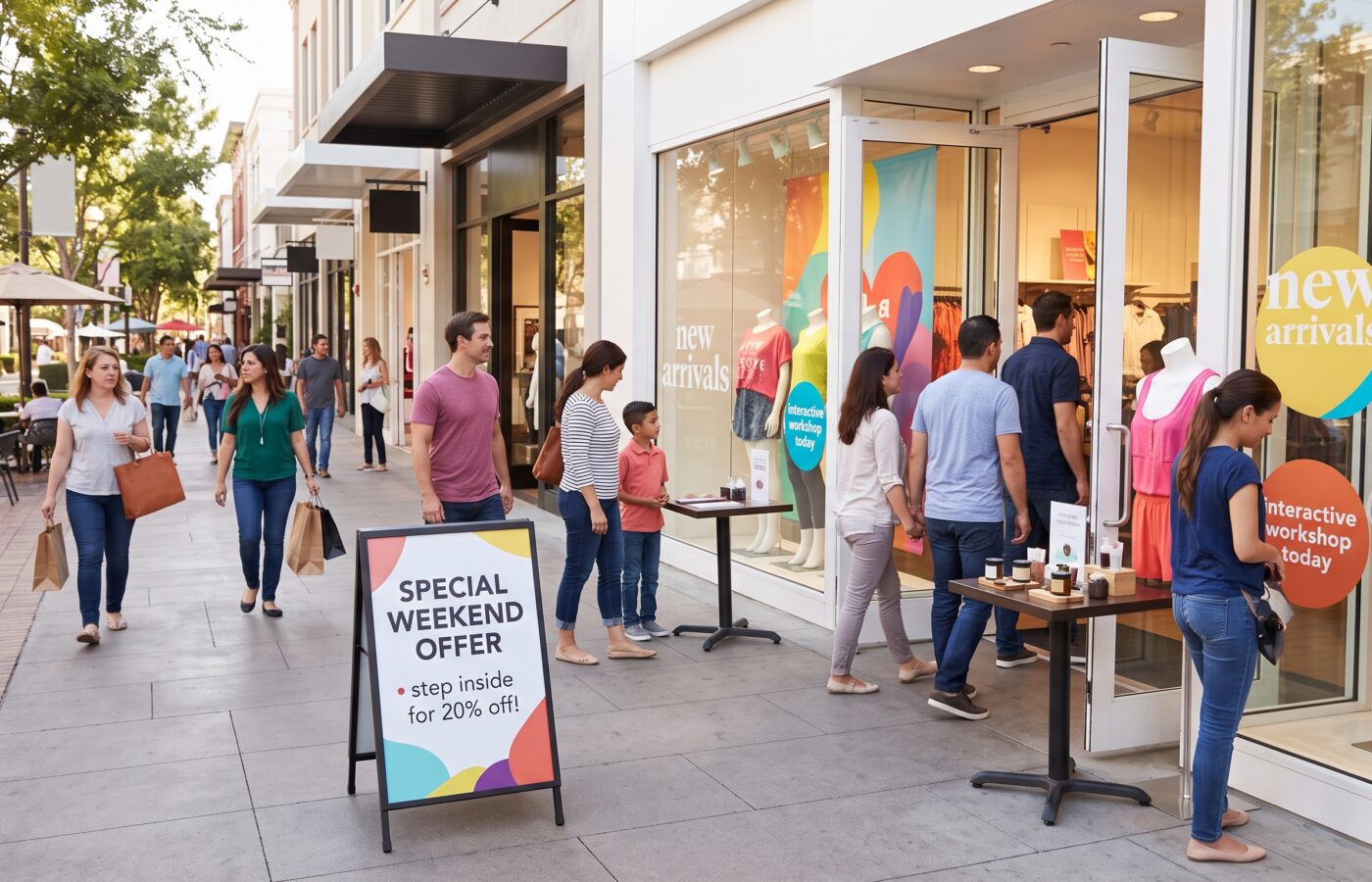
A sidewalk sign is one of the cheapest ways to increase store traffic, and one of the most wasted. Most say something like “Come on in!” and nothing else. Give people a reason instead. Mention a new arrival, a free sample today, a workshop on Saturday, or a line that makes someone smile. Rotate it every few days so it stays fresh.
Then look at your entrance. Is the door propped open when the weather allows? Is the first few feet inside cluttered with boxes or a checkout queue? Shoppers need a moment to adjust when they step in, so keep that entry zone clear and calm, and save your best displays for just beyond it.
A simple test I give every client: stand across the street with a coffee for ten minutes and watch your own store. You will learn more than any report can tell you.
Step Four: Increase Store Traffic With Experiences the Internet Cannot Offer
The strongest argument for visiting a physical store is an experience you simply cannot get through a screen. This is where independent retailers have a real advantage over large chains, because you can be personal, local, and a little bit different.
What the Research Says About Experiences
The appetite for this is well documented. A survey by Coldwell Banker Commercial Affiliates found that over half of Americans polled, 57 percent, said free samples would make them more likely to visit a physical store, and that almost 9 in 10 older Millennials said any retail experience beyond normal shopping is more likely to drive them to a store, compared to 74 percent of all U.S. adults. Research from Advantage Solutions found that 94% of shoppers said events have influenced their decisions to purchase products, and 78% have repurchased products they learned about at an in store experience or event.
This is not a new idea either. Academic work published in the Journal of Retailing and Consumer Services has examined how in store themed events affect consumers’ store choice decisions, weighing them against traditional store attributes like appearance, price image, and distance.
Events That Actually Sell
The best events are tied directly to what you sell. A kitchen store can run a knife skills night. Garden centers can host a spring planting clinic. Bookstores can hold a reading or a book club, while a clothing boutique might run a styling evening with a local stylist, and a bike shop could offer a free basic repair class. The event gives people a reason to come, and the products are right there when they want to buy.
Two tips make the difference between an event that works once and one that builds lasting traffic. First, run them on a predictable schedule so they become a habit, like the first Thursday of every month. Second, always collect contact details at the event, with permission, so you can invite people back next time.
Step Five: Turn Online Orders Into Store Traffic
If you sell online, your website can be one of your biggest sources of foot traffic. Offering buy online, pick up in store and in store returns creates visits that would never have happened otherwise. As Parcel Pending puts it, this approach entices customers to come in to pick up an item ordered online, creating a store visit they would not normally have made.
How you handle the pickup matters. Place your pickup point far enough inside that customers walk past some merchandise, but never so far that it feels like a trick. Set up a small, well chosen display near pickup with items that complement common orders. Notify customers the moment the order is ready, and keep the handoff quick and friendly. A fast, pleasant pickup earns a return visit. A slow, confusing one sends people straight back to delivery.
Returns work the same way. A shopper returning an item in person is already in a buying mood if you treat them well. Make returns painless, and offer to help them find a better fit while they are there.
Step Six: Borrow Your Neighbors’ Customers
Your neighbors are not your competition. They are a source of customers who already walk your street, and partnerships are one of the most underrated ways to increase store traffic without spending much. Team up with the café next door, the salon across the road, or the gift shop on the corner.
Simple partnerships work well. Swap discount cards so each business hands out offers for the other. Host joint events, like a late night shopping evening where several stores stay open, offer small treats, and promote together. Create a stamp card that rewards shoppers for visiting several local businesses in one month. Join your local business association or chamber and show up to their meetings, because neighborhood promotions often get organized there.
When a coffee shop regular discovers your store through a recommendation from a barista they trust, that visit carries a warmth no ad can buy.
Step Seven: In Person Promotions That Increase Store Traffic
Store only offers give people a clear reason to visit rather than browse online. According to NewStore, flash sales can boost foot traffic and also help brands clear out excess inventory quickly.
Be careful, though. If every promotion is a discount, you train your customers to wait for the next sale and never pay full price. I prefer value added promotions that cost less and build more goodwill: a gift with purchase, early access to new arrivals for loyal customers, a free personalization service, a tasting, or a limited run product only available on the shop floor.
Urgency works best when it is real. A one day event, a short seasonal collection, or a limited batch from a local maker gives people a genuine reason to come now rather than someday.
Step Eight: Use Your Customer List to Pull People Back
Your existing customers are the easiest people to bring back, and your email and text lists are how you reach them. Used well, these lists remain a reliable way to increase store traffic week after week. The mistake most stores make is sending messages that give people no reason to visit.
Every message should answer one question: why should I come in this week? New arrivals, restocks of popular items, an upcoming event, or a store only offer all qualify. A generic newsletter does not.
A loyalty program can help too, especially one that rewards visits and not just spending. Small touches like a birthday treat redeemable in store, or points that double during your slower afternoons, can shift traffic into the hours where you need it most. Your counting data from step one will show you exactly which hours those are.
Step Nine: Be Truly Local on Social Media
Social media for a physical store should feel like a window into the shop, not a catalog. Show new stock arriving, your team setting up a display, a customer trying something on, or a behind the scenes look at an event. Short, simple videos filmed on a phone often outperform polished content because they feel real.
Always tag your location so people searching your area can find you. Engage with other local accounts, including neighboring businesses, community groups, and local news pages. Consider working with micro influencers in your town, people with a few thousand engaged local followers, rather than chasing large accounts whose audiences live nowhere near you. Reply to every comment and message promptly. A shopper asking “do you have this in blue?” is one quick answer away from walking in.
Step Ten: Remember That Your Staff Are the Traffic Plan
Every strategy in this article can bring a shopper through the door once. Your people decide whether they come back.
Train your team to greet every visitor warmly without hovering. Make sure they know the products well enough to recommend with confidence. Encourage them to remember regulars and their preferences. Small moments like “we just got that brand you asked about” are exactly what turn a casual shopper into a loyal one who tells friends.
Use your traffic data to schedule staff around real busy periods. Nothing kills a good event or a busy Saturday faster than a single overwhelmed employee and a long queue. Shoppers remember being ignored far longer than they remember any promotion.
Step Eleven: Match Your Hours to Your Customers
Your opening hours should follow your customers’ lives, not habit. Look at your counts. If traffic spikes right at closing time, people are trying to reach you after work and you are shutting the door on them. Test staying open later one or two evenings a week and measure whether it helps increase store traffic in those hours.
Align your calendar with the community around you as well. School holidays, local festivals, paydays, sports seasons, and seasonal weather all change when and why people shop. When your store feels in step with what is happening nearby, it feels relevant, and relevance brings people in.
A Simple Ninety Day Plan to Increase Store Traffic
Trying everything at once is how good plans die. Here is how I usually sequence the work.
Start the first month by counting your traffic and calculating conversion, cleaning up and completing your Google Business Profile, asking for reviews, and refreshing your window and sidewalk sign.
During month two, run your first recurring in store event, launch or improve your pickup and returns process, and reach out to two neighboring businesses about a shared promotion.
By the end of the third month, review your numbers against your baseline. Keep what moved traffic or conversion, drop what did not, and adjust your staffing and hours based on what the data shows.
Then repeat. The stores that win are not the ones with the cleverest single idea. They are the ones that keep measuring, keep testing, and keep showing up.
Final Thoughts
There is no single trick that will increase foot traffic retail store owners can flip on overnight. What works is a combination of being easy to find, worth stopping for, and worth coming back to. Count your visitors, own your local search presence, make your storefront work hard, give people experiences they cannot get online, connect your online sales to your shop floor, and invest in the people who greet every shopper.
Do those things consistently and you will increase store traffic in a way that lasts, and the street outside your door will start to look a lot busier.
Frequently Asked Questions About How to Increase Store Traffic
What is the fastest way to increase store traffic?
The quickest wins usually come from completing and actively managing your Google Business Profile and refreshing your storefront window. Google explains how complete information and reviews influence local visibility in its guide on how to improve your local ranking on Google.
How do I measure foot traffic in my store?
Use a door counter or sensor and compare visitor numbers with transactions from your point of sale system to find your conversion rate. NewStore outlines several measurement options in its guide on how to increase foot traffic in a retail store.
Do in store events really bring in more customers?
Yes, especially when they are tied to your products and held on a regular schedule. Survey findings from Coldwell Banker Commercial Affiliates on experiential retail show that experiences and free samples make many shoppers more likely to visit.
Does offering buy online, pick up in store help foot traffic?
It does, and it often increases spending too, since many pickup customers buy extra items. See this summary from CSP Daily News on online pickup insights.
How long does it take to see results?
Search and storefront changes can show results within weeks, while events, partnerships, and loyalty programs typically build momentum over two to three months. Toast shares a practical step by step approach in its guide on how to increase foot traffic in retail stores.
Can a small independent store compete with big chains for foot traffic?
Absolutely. Independent stores can offer personal service, local partnerships, and community events that large chains struggle to match. Parcel Pending covers several of these tactics in its article on increasing foot traffic in a retail store.
References
- Google Business Profile Help. How to improve your local ranking on Google
- CSP Daily News. 3 Insights Into Online Pickup
- Retail Dive. OrderDynamics Research on Click and Collect Shoppers and Unplanned Purchases
- Coldwell Banker Commercial Affiliates. Shopping Experiences and Perks Driving Customers Back In Store
- Advantage Solutions. Why In Store Experiences and Events Matter
- Journal of Retailing and Consumer Services via RePEc. The Effects of In Store Themed Events on Consumer Store Choice Decisions
- WiserReview. Latest Local SEO Statistics
- Parcel Pending. How to Increase Foot Traffic in a Retail Store
- NewStore. How To Increase Foot Traffic in a Retail Store: 17 Ways
- Toast. How to Increase Foot Traffic in Retail Stores: 10 Simple Steps