
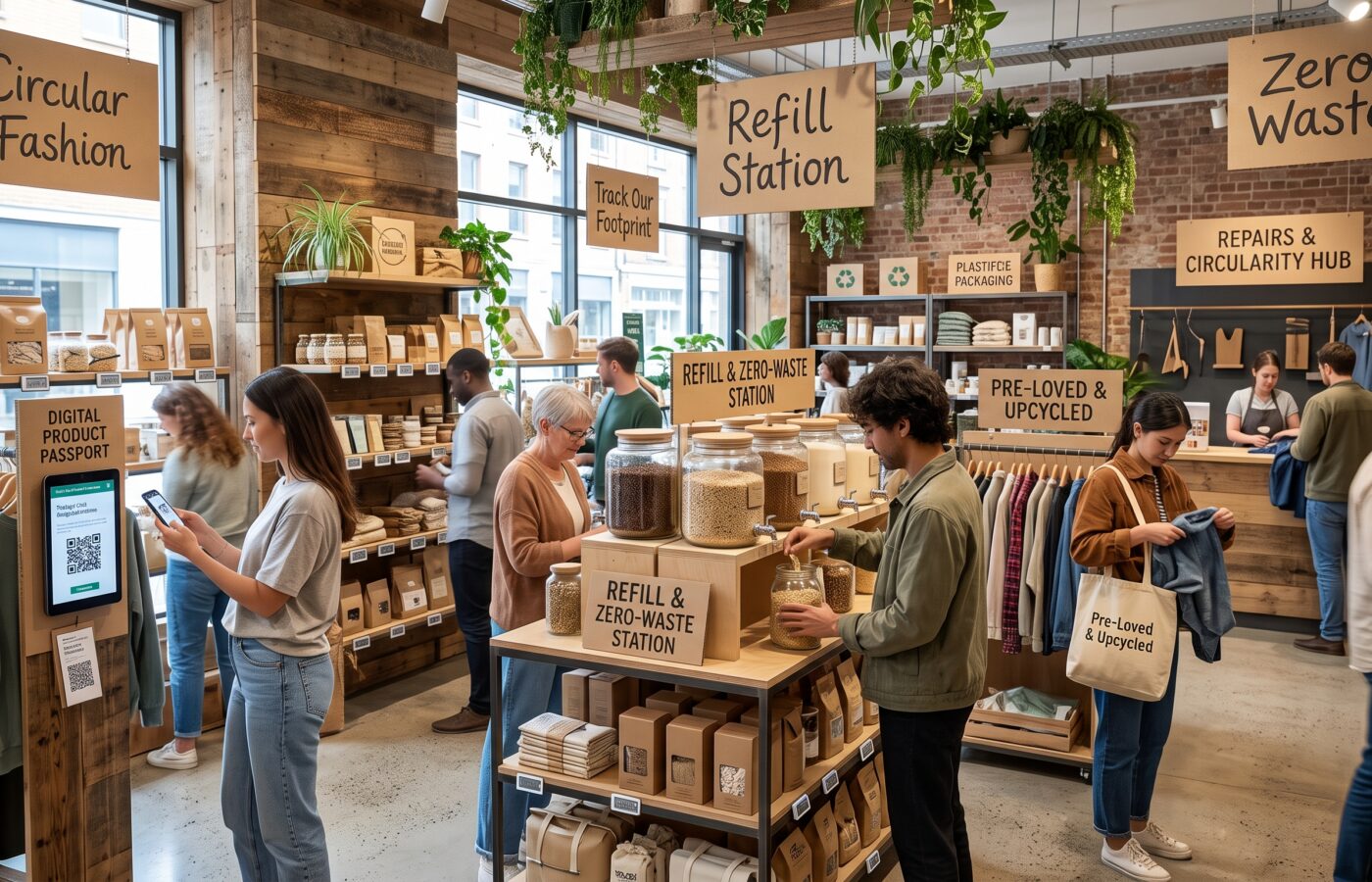
Sustainable Shopping Trends Shaping Retail in 2026

For about ten years, I sat in meetings where sustainable shopping trends were the slide near the end of the deck. They usually came after pricing, after the holiday plan, and even after the new loyalty app. Everyone agreed they mattered; however, almost nobody gave them a budget line of their own.
Now that era is over. Retailers did not suddenly find their conscience. Instead, shoppers, regulators and the economics of inventory all moved at the same time. When I sit down with merchants this year, the sustainability conversation no longer centers on brand image. Rather, it covers margin, compliance, customer acquisition and whether the product data in their catalog will survive scrutiny.
This piece walks through the shifts that I see actually changing how stores operate in 2026. Consumer behavior drives some of them. Meanwhile, law drives others. Finally, a few come from the plain fact that throwing away good stock now costs a lot and, in parts of the world, breaks the law. So if you run an online store, a physical shop, or both, every one of these touches your business.
Why Sustainable Shopping Trends Feel Different in 2026
Retail has declared a “year of sustainability” more times than I can count. What makes this one real, though, is that pressure now comes from several directions at once, and each one reinforces the others.
Shoppers Are Changing Where They Spend
First of all, consumers are not just saying they care. In fact, they are moving their money. DHL’s ecommerce research found that 7 in 10 shoppers worldwide pick sustainable products or delivery options when they buy online, and close to half buy used or refurbished goods. That second figure keeps merchants up at night, because every refurbished phone or secondhand jacket is a purchase that might otherwise have gone to a new item.
Regulators and Technology Are Raising the Bar
At the same time, the rules now have teeth. Europe switched on several major regulations this year, and they reach anyone who sells to EU customers, wherever that business sits. As a result, commentators now describe 2026 as an “age of accountability” for sustainable shopping, where tighter rules, especially in the EU, push brands to back up environmental claims instead of greenwashing.
The third force is quieter but just as important: technology. AI shopping assistants, digital product records and resale software make it far easier for a customer to compare, verify and choose. Naturally, when the tools get easier, behavior follows.
Put those three together, and you get a market where sustainability no longer works as a nice extra. Instead, shoppers, platforms and regulators all apply it as a filter before a sale happens.
Resale Leads the Sustainable Shopping Trends of 2026
If I had to pick the single most important of the sustainable shopping trends this year, I would choose the mainstreaming of resale. Five years ago, secondhand was a niche channel that brands merely tolerated. Today, by contrast, it competes head on with new merchandise.
The Numbers Behind the Shift
ThredUp’s latest report makes the point plainly. For example, the US secondhand apparel market, which counts online resale, in store resale and thrift, grew 19% in 2025, its fastest pace since 2021 and roughly 3.6 times faster than the wider clothing market. Likewise, the same report expects the global secondhand apparel market to hit $393 billion by 2030, growing about 9% a year and taking roughly a tenth of all apparel spending. In addition, 59% of consumers bought used clothing in 2025.
What strikes me most, however, is who drives it. ThredUp projects that Gen Z and millennials will account for over 70% of resale growth through 2030, with first time resale shoppers making up most of the spending. Clearly, these are not occasional thrifters. In fact, ThredUp’s CEO calls them “resale natives,” a generation that grew up buying secondhand and now reaches its peak spending years.
Who Wins the Resale Customer
The competitive map is shifting too. Analysts note that recommerce now sits inside the main retail journey, where big marketplaces, specialist refurbishers and retailers with their own resale channels all compete. For instance, in February 2026, eBay agreed to buy Depop from Etsy, adding a younger fashion resale platform to its business. After all, when the largest marketplaces start buying resale apps, you know the channel has grown up.
For retailers, therefore, this creates a choice. You can watch your customers sell your products on someone else’s platform, or alternatively you can bring that activity in house. Brand run resale, trade in credit and certified refurbished programs all keep the customer relationship, and the second sale, inside your own ecosystem. Indeed, I have seen mid sized apparel and electronics sellers launch simple trade in schemes and win back customers who had drifted to marketplaces.
One detail matters for anyone planning a program: the report finds that the supply of secondhand goods, not shopper demand, limits resale growth. That flips the usual retail problem. In other words, the hard part is not selling used items. Instead, it is getting enough good ones in the door, and a retailer with an existing customer base therefore holds a real advantage.
Sustainable Shopping Trends Meet Tough Green Claim Rules
For years, a leaf icon and the word “eco” did a lot of heavy lifting on product pages. That shortcut has now closed, at least for anyone selling to European consumers.
What the New EU Rules Ban
On 27 September 2026, the EU Directive on Empowering Consumers for the Green Transition took effect. Specifically, it adds new banned practices, including vague or generic environmental claims that lack reliable, verifiable evidence. As a result, terms you have seen on thousands of product listings now sit in the firing line. The rules ban generic claims such as “environmentally friendly,” “ecological,” “green,” “eco sustainable,” “energy efficient” or “biodegradable” when a business cannot prove the claimed performance, for example through the EU Ecolabel or another recognised certification.
Moreover, the directive gives no grace period for old packaging or existing listings, which surprised several merchants I work with. Every environmental claim and sustainability label shown to consumers must comply from the start date, existing products included. The rules also reach businesses outside the EU, since any trader selling to EU consumers must comply. Above all, the stakes are real: some advisers warn that regulators could fine noncompliant businesses up to 4% of annual turnover.
Similarly, the rules tightly control promises about the future. The European Commission’s updated guidance only allows claims about future environmental performance when clear public commitments, detailed plans, measurable targets and regular independent verification support them. Consequently, “carbon neutral by 2035” on a product page no longer counts as a harmless aspiration. Instead, it is a legal statement that needs a paper trail.
How to Write Claims That Hold Up
In practice, this is one of the healthier sustainable shopping trends, because it rewards the businesses that did the real work. When I audit a catalog now, I go line by line and ask one question: can we prove this, specifically, with a document we could hand to a regulator tomorrow? If the answer is no, then I rewrite the claim or remove it. Specific beats general every time. For example, “Made with 60% recycled polyester, certified by [scheme]” is both safer and more persuasive than “eco friendly fabric.”
Even outside Europe, I recommend treating these rules as the global standard. After all, customers in every market keep getting better at spotting fluff, and one set of honest, specific claims is far easier to manage than different versions for each region.
Unsold Stock and the New Sustainable Shopping Trends
Customers rarely see one part of retail: what happens to the goods that do not sell. For a long time, some brands simply destroyed them to protect pricing and clear warehouse space. Now, however, that option is disappearing.
Inside the EU Destruction Ban
Since 19 July 2026, the Ecodesign for Sustainable Products Regulation has stopped large companies across the EU from destroying unsold clothing, fashion accessories and footwear. The scale of the problem explains why. According to the European Commission, companies in Europe destroy 4 to 9% of unsold textiles each year before anyone wears them. Furthermore, Germany discards around 20 million returned products annually, and France destroys unsold goods worth roughly €630 million.
The ban is not absolute; still, the exceptions are narrow. The rules only permit destruction in exceptional cases, such as safety risks or irreparable damage. Transparency forms part of the package as well. Specifically, companies must report how much unsold stock they throw away using a standard format, with the first reporting cycle beginning in February 2027. Smaller players, on the other hand, have some breathing room for now: medium sized businesses have until 19 July 2030 to comply.
What It Means for Inventory Planning
This changes inventory planning in a fundamental way. Once destruction stops being an exit, overbuying costs far more. Therefore, the merchants handling this best tighten their demand forecasts, build relationships with outlet channels, donation partners and resellers, and design returns flows that let them clean and resell items quickly. In addition, industry coverage suggests the ban will likely push more clothing and footwear into the resale supply, and that marketplaces may need to change automatic destruction settings and give sellers better resale, donation and recycling options.
Notice how neatly that connects to the resale shift above. A law that stops companies from burning good stock also partly solves the supply problem that limits resale growth. In short, these sustainable shopping trends do not exist in isolation; instead, they feed each other.
Product Passports Power Sustainable Shopping Trends
Most shoppers have not heard of the Digital Product Passport yet. Even so, within a few years I expect many of them will scan one without thinking about it, just as they scan a QR menu at a restaurant.
What the Passport Covers
The passport sits inside the same Ecodesign regulation that created the destruction ban. As one retail compliance specialist puts it, ESPR is already in force, and if ESPR is the framework, the passport is the tool for enforcement and transparency. The first priority categories include iron, steel, aluminium, textiles, tyres, furniture, ICT and electronics. In addition, a passport needs to cover materials, performance data, substances of concern, carbon footprint and lifecycle instructions.
The rollout moves gradually, though. Requirements will arrive in phases through delegated acts under the ESPR Working Plan for 2025 to 2030. Understandably, that staggered timeline tempts some retailers to wait. Nevertheless, I think that is a mistake, for two reasons.
Why Early Movers Gain
First, the data work moves slowly. Gathering verified material and supplier information across hundreds or thousands of SKUs takes time, so the businesses that start early will not scramble when their category’s deadline arrives. Second, and more interesting to me, the passport does more than create a compliance burden. In fact, it builds trust. For instance, a customer who can scan a jacket and see where the fabric came from, how to repair it and how to recycle it has a reason to choose that jacket over an anonymous one.
Besides that, the passport links directly to resale. A product that carries a verified digital record is easier to authenticate, price and resell. As a result, passport data will make the second, third and fourth life of a product far smoother, which is exactly what the circular economy needs.
Delivery and Returns Join Sustainable Shopping Trends
For a long time, sustainability conversations focused on the product. Increasingly, however, shoppers look at how the product reaches them and what happens if they send it back.
Shoppers Judge the Whole Journey
The DHL research I mentioned earlier makes this concrete. Almost a third of global shoppers, 31%, say they would only buy from retailers that use a sustainable delivery and returns provider. That is not a slight preference. On the contrary, for nearly one in three buyers, it is a dealbreaker. The same research also names Malaysia, Nigeria, Saudi Arabia, India and Austria as leaders in sustainable retail practices, a useful reminder that this story reaches well beyond Western Europe and North America.
Every ecommerce operator knows the tension here. Shoppers still expect same day or next day delivery from online stores, and yet speed and sustainability often pull in opposite directions. For this reason, the retailers handling this well offer choice at checkout: a standard option, a faster option, and a consolidated or lower impact option with a clear explanation. Many customers will happily wait an extra day when they understand why, especially with a small incentive attached.
Returns Are the Hidden Cost
Returns form the other half. Serial returning drives emissions, packaging waste and, as the German figures above show, a shocking amount of destroyed product. Fortunately, better size guidance, honest product photos and detailed descriptions cut returns at the source. Then, when customers do send items back, routing them straight into resale or refurbishment rather than a distant warehouse keeps value and reduces waste.
AI Assistants Accelerate Sustainable Shopping Trends
Artificial intelligence is reshaping almost every part of retail, and sustainable shopping is no exception. What feels new in 2026, however, is that shoppers actively ask AI to help them make better choices.
“Agentic commerce” increasingly shapes shopping this year, with AI assistants handling much of the product discovery and recommendation before sending shoppers to a merchant’s checkout. In resale specifically, adoption already runs high. For example, ThredUp found that 48% of shoppers use AI tools while buying secondhand, and 63% feel comfortable letting AI make purchases for them.
This matters for sustainability because AI assistants can only work with the product data they read. So if your listings carry clear, structured, verifiable details about materials, origin, certifications and care, an AI agent can surface your product to a shopper who asked for “a durable rain jacket made from recycled materials.” By contrast, if your listings say “eco friendly” and nothing else, the agent has nothing to work with, and in Europe, that vague phrase may now create legal risk too.
That is why I tell clients to think of their product data as the new storefront window. A human shopper may skim it. An AI shopping agent, on the other hand, will read every word and compare it against every competitor in seconds. Ultimately, specific, honest and structured information wins.
Personal Benefit Drives Sustainable Shopping Trends
Something surprised even me when I dug into the latest consumer research. Guilt about the planet does not drive most sustainable behavior. Instead, personal benefit does.
Health and Safety Come First
Sustainable Jungle’s 2026 consumer report, drawing on GlobeScan research, notes that personal health and safety now act as the strongest driver of sustainable behavior change, and that only 7% of consumers care about sustainability on its own. In plain terms, people buy the nontoxic cleaner because it keeps their kids safer, and the environmental benefit then arrives as a welcome bonus.
Value Still Rules the Basket
Value forms the other part of the equation. After all, living costs remain a pressure point across many markets. For example, IGD’s 2026 trend forecast for UK grocery lists affordability, elevated experiences, simplified sustainability and health as the four trends shaping shopper behavior, and it notes that value will stay a top priority while economic pressure lasts. IGD also argues that making sustainable choices visible, with clear benefits, will drive shopper engagement.
Younger shoppers, meanwhile, remain especially engaged. Attest research shows more than two thirds of Gen Z consumers see sustainability as important when picking beauty products, and over 70% prioritise it when choosing food. Even with this group, though, the message lands best when you connect it to quality, durability and price per wear rather than abstract virtue.
That explains why resale, repair and refurbishment keep winning. Simply put, they are the rare sustainable choices that also save the customer money. So when the green option is also the cheaper option, you do not need a long campaign to sell it.
How Retailers Can Act on Sustainable Shopping Trends
Of course, trends only help if they change what you do on Monday morning. Based on the work I do with merchants right now, here is where I would focus.
Fix Claims, Resale and Stock First
- Audit every environmental claim. First, go through product pages, packaging, ads and email templates. Then remove or rewrite anything generic, and replace it with specific, provable statements tied to recognised certifications.
- Start a simple resale or trade in program. You do not need a full marketplace on day one. Instead, test a trade in credit scheme or a certified refurbished section with a single category.
- Rethink your end of season plan. Build outlet, donation, resale and recycling routes for unsold stock before you need them. At the same time, tighten your buying so you need them less.
Then Tackle Data, Delivery and Messaging
- Clean up your product data. Structure materials, origin, care instructions, certifications and repair information consistently. As a result, you prepare for product passports and become visible to AI shopping assistants.
- Offer lower impact delivery choices. Give customers a clear, honest option at checkout and explain the tradeoff. After that, track how many choose it.
- Attack returns at the source. Invest in better sizing tools, accurate photography and honest descriptions. Also route returned items to resale where possible.
- Lead with personal benefit. In your marketing, talk about durability, health, safety and long term value first. Then let the environmental benefit support the story rather than carry it alone.
None of these require a massive transformation budget. Rather, they require attention and follow through, which is exactly what sustainability lacked when it lived on the last slide of the deck.
The Bottom Line on Sustainable Shopping Trends
In the end, the sustainable shopping trends shaping retail in 2026 share one thread: proof. Shoppers want proof that a product matches its claims. Likewise, regulators now demand proof before a green claim goes on a label. Similarly, resale platforms need proof of authenticity and condition. Finally, AI assistants reward proof in the form of clean, structured data.
For that reason, the retailers who thrive over the next few years will not shout the loudest about sustainability. Instead, they will hold the most honest product information, plan inventory the smartest and give customers a genuine way to pass products on to a second life. That path is admittedly harder than printing a leaf on a box; nevertheless, it builds loyalty that lasts.
Written by a Sustainable Retail Specialist
Sustainable Shopping Trends FAQ
What are the biggest sustainable shopping trends in 2026?
The main ones include the growth of resale and recommerce, strict rules against vague green claims, the EU ban on destroying unsold clothing and footwear, digital product passports, demand for greener delivery and returns, and AI assisted shopping. For a starting point, see ThredUp’s 2026 Resale Report and DHL’s sustainability and circular economy research.
Do EU green claim rules apply to businesses outside Europe?
Yes. In fact, any trader selling to EU consumers must comply, wherever the business sits. TLT’s guide to the Green Transition Directive explains what businesses need to do.
Which environmental claims do the new EU rules ban?
The rules prohibit generic terms like “green,” “eco friendly” or “environmentally friendly” unless the business can show recognised excellent environmental performance. For more detail, both Latham & Watkins and PwC Italy break down the specifics.
What is a Digital Product Passport?
It is a digital record attached to a product that carries information about materials, environmental impact, repair and recycling. Currently, the EU is phasing it in under the Ecodesign regulation from 2026 to 2030. See PTC’s retail guide and EuroShop’s overview.
Can retailers still destroy unsold clothing in the EU?
Since 19 July 2026, the EU has stopped large companies from destroying unsold apparel, accessories and footwear, apart from narrow cases such as safety risks or irreparable damage. Medium sized businesses then follow in 2030. Beveridge & Diamond and nShift cover the timeline.
How can a small online store take part in sustainable retail?
First, start with honest, specific product information. Next, offer a lower impact shipping option, reduce returns with better sizing and photos, and test a small trade in or refurbished line. In addition, Attest’s retail trends guide offers useful context on what shoppers expect.
References
- 2026 Sustainability and Circular Economy Trends, DHL eCommerce
- 2026 Resale Report, ThredUp
- US Resale Market to Surpass $78 Billion by 2030, Retail Dive
- ThredUp: US Secondhand Apparel Sales to Hit $78.8B by 2030, Chain Store Age
- Resale Market Will Hit Nearly $400 Billion by 2030, The Ethos
- Global Recommerce Market Intelligence Databook, Research and Markets
- EU Empowering Consumers Directive: New Rules on Green Claims, Latham & Watkins
- Greenwashing, the European Crackdown, PwC Italy
- EU EmpCo Directive Overview, Anthesis Group
- The EU’s Green Transition Directive: What Your Business Needs to Do, TLT
- Commission Updated Q&A on the Green Transition Directive, European Outdoor Group
- Ban on the Destruction of Unsold Clothing and Footwear Now in Force, Natur Pack
- EU Clarifies Ban on Destruction of Unsold Apparel, Beveridge & Diamond
- European Commission Prohibits Destroying Unsold Textiles, Footwear Magazine
- EU Ban on Destroying Unsold Clothing Enters Into Force, Cross Border Magazine
- Getting Ready for the EU Digital Product Passport, PTC
- ESPR Guide, Circularise
- EU Digital Product Passport Compliance Guide, ASUENE
- 17 Key Consumer Trends From Around the World, myPOS
- Retail Trends 2026, Attest
- IGD 2026 Trends for UK Shoppers, Fresh Produce Journal
- Sustainable Consumer Report 2026, Sustainable Jungle